


Note: This essay is based on a talk I gave at GenerationAI’s conference in Paris on December 10th. The video version of it is available here.
—
We’re living through a golden age for people who work solo.
Tools and capabilities that used to require entire teams are now accessible to anyone. A single designer can deliver agency-level work. An indie developer can ship products that look like they came from an extensive team. A solo consultant can compete with McKinsey on research depth. For the first time in history, you can do sophisticated, high-value work entirely on your own terms. But there’s a strange contradiction at the heart of this moment. The same tools and mindset that make us more capable can also, if we’re not careful, make us less skilled.
I’ve spent 15 years working independently at the intersection of emerging technologies, the future of work, and adult education. As a “Company of One” myself, I’m not just observing this paradox. I’m living it. And what I’m learning - what many of us working this way are learning - matters for everyone else as this pattern ripples outward as you read these words.
What is a “Company of One”?
The “Company of One” originates from Paul Jarvis’s 2019 book of the same name. It describes a specific business philosophy for building a practice, both simple and profound: you can grow smarter and better without necessarily growing bigger. Instead of asking, “How do I scale up?” you can ask, “How do I improve intentionally?” You’re not optimizing for maximum size. You’re optimizing for maximum agency and quality of work.
Companies of One are built on resilience and control. They prioritize autonomy, speed, and simplicity. They’re run by hyper-adaptable professionals who’ve mastered their core skills and can move fast precisely because they’re not encumbered by organizational complexity. They are not rejecting growth or remaining small for its own sake, but more about questioning the assumption that bigger is always better, and instead asking: what would it look like to become more capable without becoming more complex?
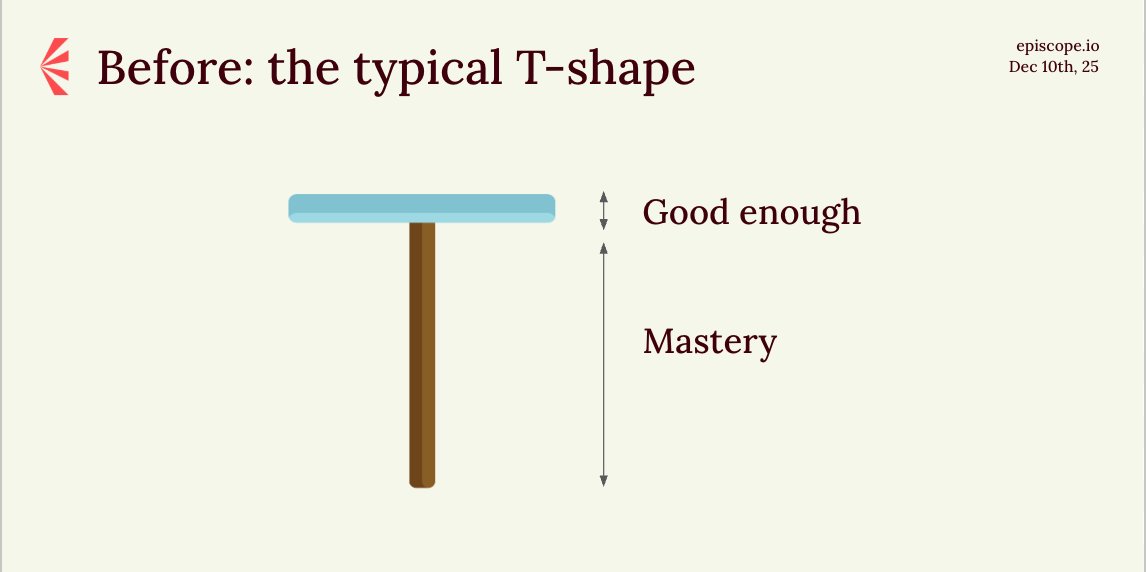
Before AI, becoming a successful Company of One required a specific skill architecture. You needed to be what’s often called “T-shaped”: deep mastery in one area (the vertical stroke of the T) and competence across the rest of your value chain (the horizontal stroke). You’d develop genuine expertise in your core discipline, whether that was design, development, strategy, or writing, yet you would also need to be good enough at everything else required to run an independent practice: communication, sales, operations, basic finance, and even rudimentary HR when you hired contractors. The breadth wasn’t stellar, but it was sufficient. You were a generalist with one deep spike of expertise.
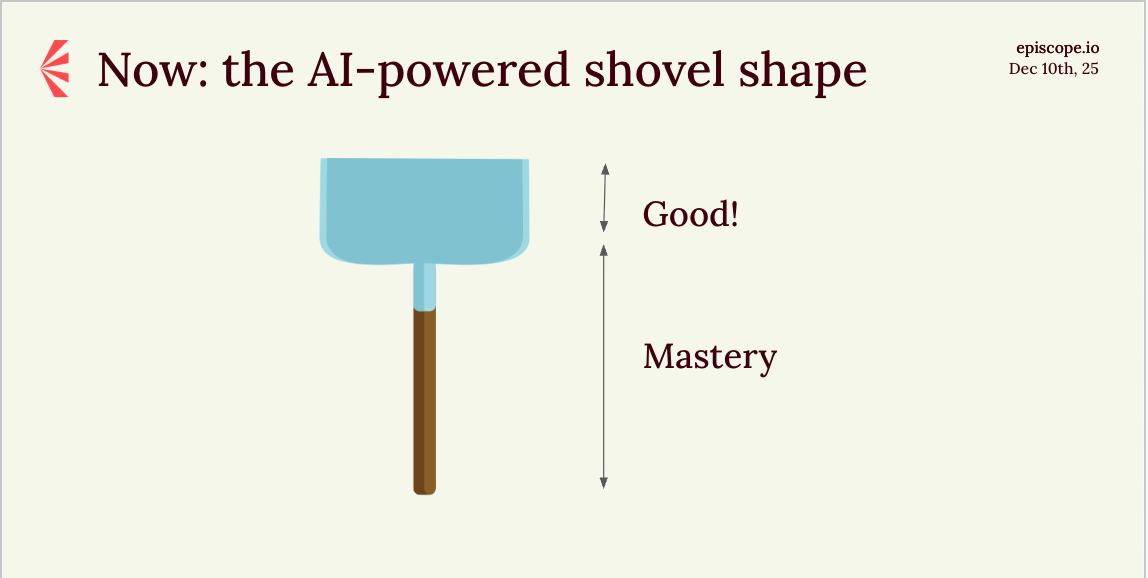
Today, AI is transforming what’s possible, and that shape is growing into what I call the “shovel-shape”. You still need that deep mastery at your core. That’s non-negotiable. But now, for everything else in your value chain, AI helps you bridge the gap between having vocabulary and context versus having deep expertise. You can move from “good enough” to genuinely “good” with AI as your coach. A simple example: building a professional website used to require either hiring specialists for the whole length of the project. Now, with the right inputs (clear messaging, solid corporate identity, thoughtful structure), a myriad of tools can help you create something genuinely professional. This is incredibly powerful. The golden age for generalists just got goldener.
But this is also where the risk becomes acute.
The seductive pitch
A few weeks ago in San Francisco, I walked past an advertisement that crystallized something I’d been sensing. “Sleep in. Let Ona work 996.” The ad’s promise was elegantly simple: automate everything, sleep in, reclaim your life. In short: Wake up refreshed while your AI assistant grinds through the work week. This pitch landed on my ears as fairly cynical. Not because it is technically impossible. As we know, the technology works. But because embedded in that promise lies a fundamental misunderstanding about what we’re actually delegating when we hand work to AI.
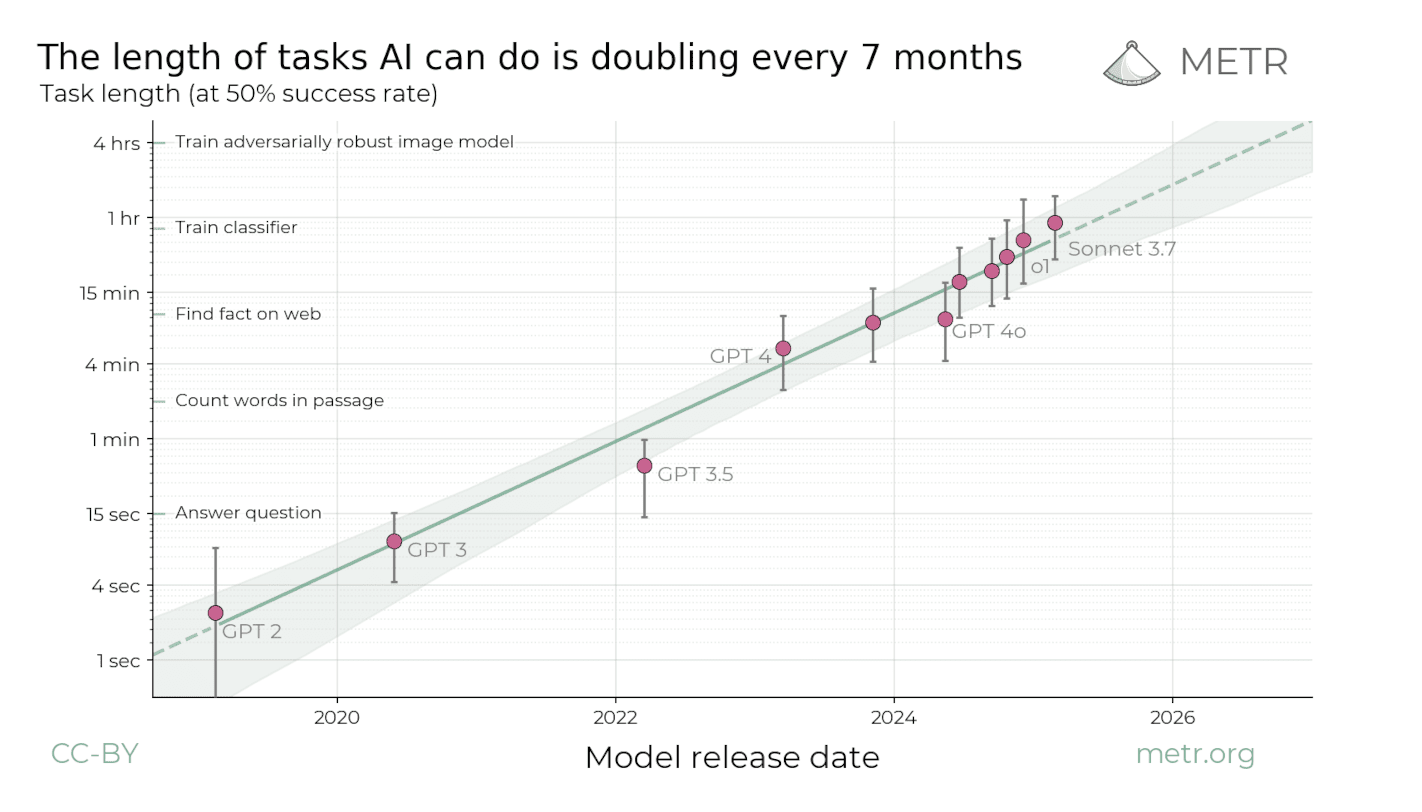
Consider this: Research from METR tracks the length of tasks AI systems can handle and shows that capabilities are doubling every seven months. Four-hour analysis projects are now complete in minutes. Impossible tasks from 2020 are routine. For knowledge workers, this creates a potentially existential problem. The tasks we built our value propositions around (research, drafting, analysis, design) exist on a moving target. What commands premium rates today might be table stakes in six months, commoditized in twelve.
The tension is already palpable, and indeed, you can fall asleep yet might wake up work-free… but also jobless.
The magnifier effect
Companies of One are experiencing this shift first and most acutely. No team to buffer the changes. No organizational inertia to slow adoption. No corporate structure to absorb the shock when AI eliminates a skill you spent years building.
This could make us canaries in the mine, yet I prefer to think of us as magnifiers. We’re not warning of danger. We’re showing patterns before they become obvious to everyone else. What’s happening to us now will ripple through corporate structures, large teams, and traditional organizations over the next few years. We’re also learning to refocus and adapt fast.
The question is then: what are Companies of One learning at the leading edge?
Three Lessons from Companies of One
What practices are emerging from those of us experiencing this transformation first?
Lesson One: Essentialise Your Craft
The first lesson is about value, not tasks. Companies of One develop have a craftsperson mindset: you become obsessed not with what you do, but with what value you offer the world. The tasks you execute are fungible. The judgment, synthesis, and context you bring are not.
If you’re a copywriter, your value isn’t writing sentences. It’s understanding audience psychology and creating messages that move people to action. Yes, AI can generate copy that’s on-brief and grammatically perfect. But you’re building something AI isn’t: the intuition for what resonates that comes from watching hundreds of campaigns succeed and fail. If you’re a developer, your value isn’t writing code. It’s architecting systems that solve real business problems. AI can write functions, debug syntax, and even suggest patterns. But you’re making context-dependent tradeoffs (speed versus maintainability, technical debt versus shipping fast) based on where this specific company is in its lifecycle. As a strategist, my value isn’t making slide decks. It’s synthesizing weak signals, connecting dots across domains, and helping leaders see around corners. AI can summarize research beautifully. But I’m the one who knows which anomaly in the data actually matters, and why.
The pattern becomes clear: judgment, synthesis, context, and relationships matter. Execution increasingly doesn’t. And here’s why this matters profoundly: AI is commoditizing execution for everyone. What used to differentiate you (speed, accuracy, volume) are table stakes now.
The premium is moving away from “can you do this?” toward “do you know what to do, and why?”
Lesson Two: Be Intentional About Your AI Tandem
The second lesson is about how you use these tools. Bharat N. Anand and Andy Wu recently published a framework in Harvard Business Review that helps clarify this.
The core of the craft lies in the “human-first” zone: tacit knowledge, high cost of error. Strategy development, relationship building, judgment calls. You must lead here. If you offload this work, you’re not just losing output quality. You’re stopping yourself from thinking and getting new skills. Other quadrants can onboard AI as a first contributor (“Creative catalyst” and “Quality control”) and even as a solo contributor (“No regrets”), but this dark purple quadrant defines your craft today and even more tomorrow.
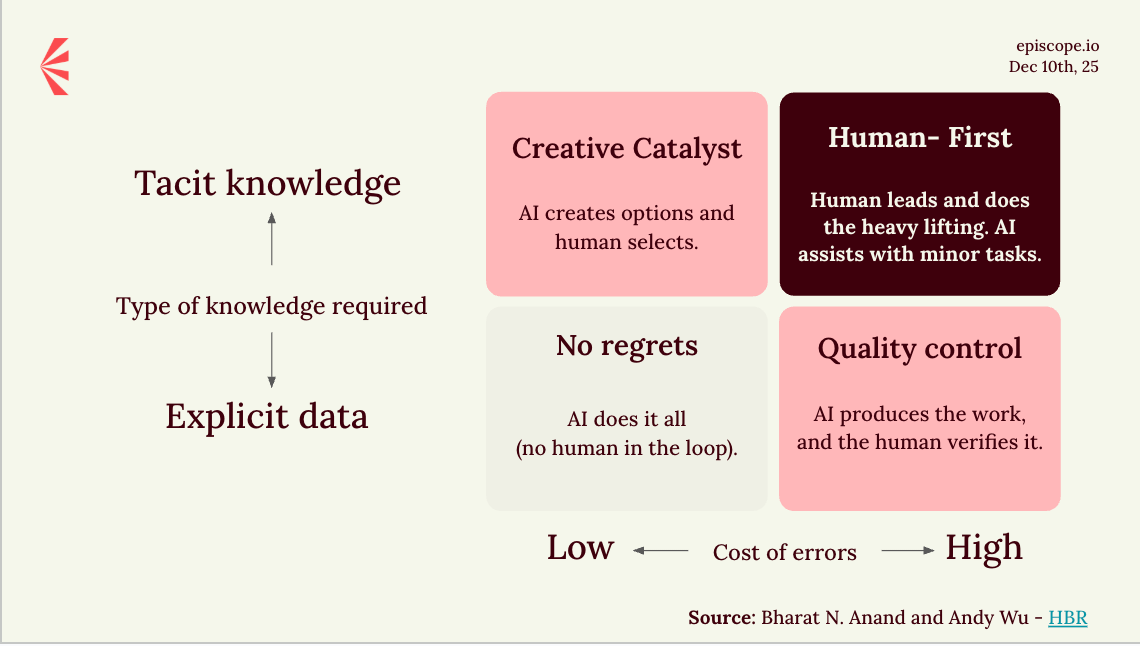
What I’m finding in my own practice is that the question shifts from “can I automate this?” to “which automation makes me more valuable over time, and which slowly erodes the foundation of my expertise?” This is intentional automation.
That is also the work I do: helping organizations and individual practitioners navigate this transformation without losing what makes them valuable. Not by rejecting these tools, but by being thoughtful about how we integrate them into their businesses.
Lesson Three: Practice JONA (The Joy of Not Automating)
The third lesson is, in my opinion, the most important: it is the Joy of Not Automating (JONA). I hope we can make this acronym stick, because it captures something essential that’s missing from most conversations about AI and work.
JONA isn’t about resisting technology or romanticizing difficulty. It’s about understanding that there’s a profound difference between delegating tasks and delegating learning, between using tools to augment your capability and using tools that replace the experiences through which capability develops. JONA has two dimensions.
The first is qualitative: it’s about interaction patterns and the nature of work.
Affordance theory, developed in 1977 by psychologist James Gibson and applied to technology by Don Norman, describes how objects suggest their own use. A door handle affords pulling. A button affords pushing. The design makes certain actions feel obvious, natural, almost inevitable. AI tools have strong affordances for delegation. The interface makes it easy to ask for output. The speed of response makes it tempting to rely on. The quality of results makes it feel reasonable to trust.
But here’s what I’m noticing in my own practice and in conversations with other independent practitioners: we’re developing interaction patterns that feel efficient in the moment but erode capability over time.
The Shortcut Pattern happens when you use AI to skip thinking. Preparing for a client call? Ask AI to analyze their business and generate questions. It works. You show up prepared. But gradually, the risk is that you’re training yourself out of genuine curiosity, the kind of presence that makes clients feel understood rather than processed.
The Outsourcing Pattern emerges when you treat AI as an oracle. Need to understand a competitive landscape? Ask AI to map it, accept the output, and present it. But you’re training yourself out of the ability to notice adjacent industries that might disrupt this space, out of the instinct to ask “wait, why would they do that?” which often becomes the breakthrough insight.
The Generation Pattern shows up in creative work. Give AI your notes and ask it to write the article. It produces something polished. You edit lightly and publish. But you’ve opted out of the clarity that comes from forcing yourself to articulate your thinking, out of the distinctive voice that develops when you wrestle with finding exactly the right word.
Each pattern feels rational in isolation. Each delivers results. But here’s what research on deliberate practice tells us: expertise is built through struggle. Anders Ericsson’s work showed that mastery isn’t just about accumulated hours. It’s about the quality of engagement during those hours, the struggle, the friction, the repeated attempts to do something slightly beyond your current capability. When you remove that friction, you don’t just save time. You stop developing. Your craft isn’t just what you can do. It’s who you become through doing the work. When a designer spends years perfecting layouts, they’re not just learning software. They’re developing an eye. When a strategist spends years synthesizing research, they’re not just learning frameworks. They’re developing judgment. The question isn’t “Can AI do this?” It’s “How am I interacting with AI, and what is that interaction training me to become?” JONA is about protecting the interactions that build craft, not just the joy of doing the work.
The second dimension is quantitative: it’s about systemic forces.
Because you’re not always in control of what gets automated. Stanford’s SALT Lab (Yijia Shao, Humishka Zope, Yucheng Jiang, Jiaxin Pei, David Nguyen, Erik Brynjolfsson, Diyi Yang) recently mapped thousands of tasks along two axes: AI capability versus worker desire for automation. What they found should concern us: 41% of tasks being automated fall in the “Red Light Zone,” high capability to automate but low desire from workers to automate them. These are tasks people want to keep doing. Tasks they find meaningful. And critically, tasks where expertise gets built.
This isn’t just individual preference. It’s a systemic mismatch. Companies optimize for what’s automatable. Tool builders optimize for what’s technically possible. Clients optimize for faster and cheaper. Nobody is optimizing for what preserves human capability. Which means JONA can’t be passive preference. It needs to be active defense. You need to protect what you want to keep doing, because economic pressure, organizational metrics, and tool design are all pushing you to automate it away.
Tandem: A Desirable Future
So what does it look like when Companies of One (and any other knowledge worker) get this right? When you practice JONA and build intentional automation into your craft?
I think of it as the evolution to a third shape. We started with the T-shape: deep mastery plus good-enough breadth. AI transformed that into the shovel: deep mastery plus genuinely good breadth. But the desirable future isn’t just about expanding capability. It’s about intentional collaboration with AI. This is the Tandem way.
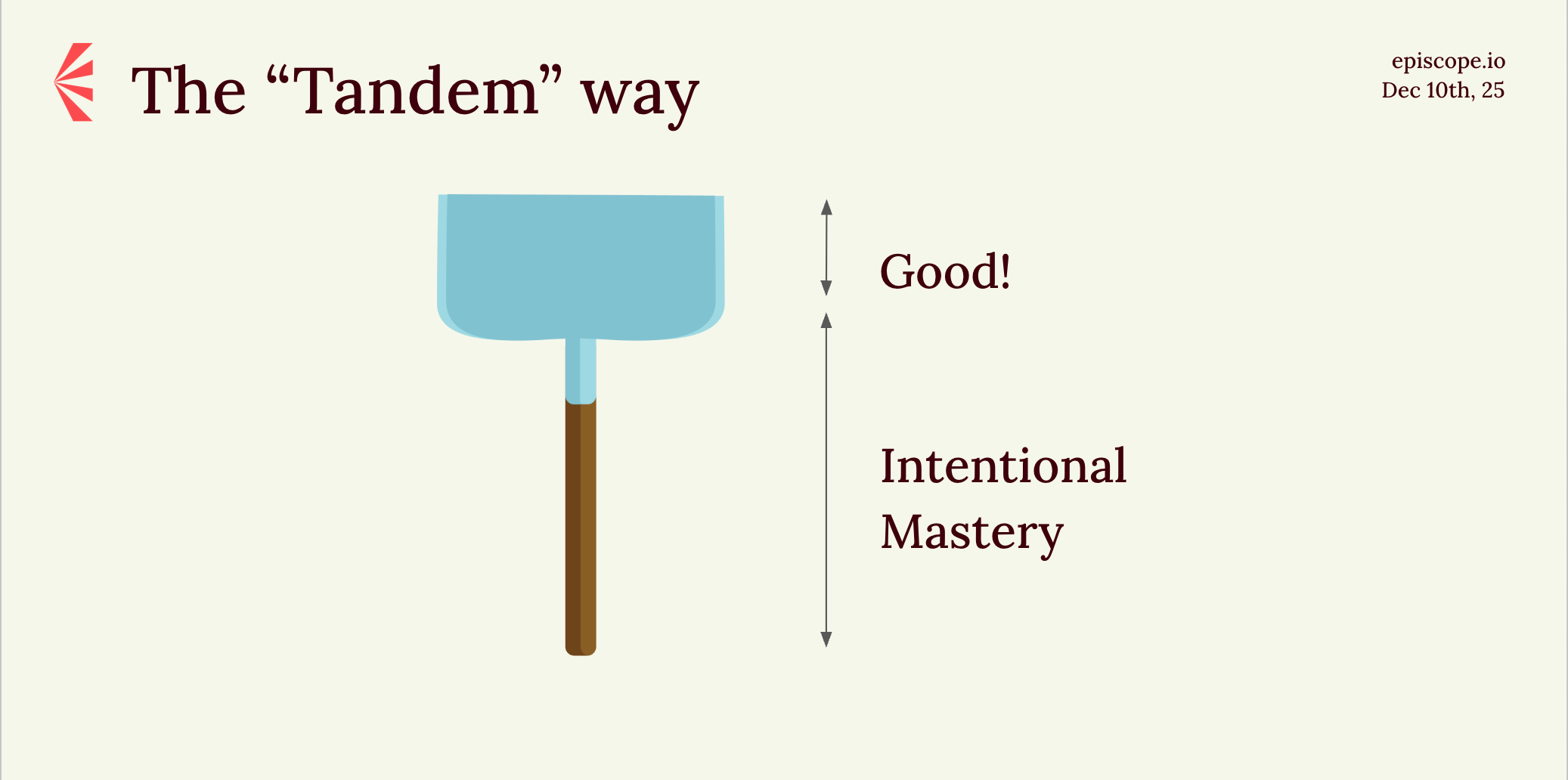
In Tandem, you’re not just using AI to do more. You’re orchestrating a dance where each partner does what they do best. AI handles the baseline. You focus on the breakthroughs. AI does the research aggregation. You do the synthesis that reveals something new. AI generates the first draft. You add the insight that makes people stop scrolling. AI runs the analysis. You spot the pattern nobody else saw.
This is what’s becoming clear in conversations with clients and fellow practitioners: the market is changing what it values. It used to be “Can you do this?” Now it’s increasingly “Can you do this in a way that actually differentiates us?” The answer to that question isn’t more automation. It’s more judgment. More taste. More expertise comes from staying in the game.
This is why I’m increasingly focused on creating practice spaces. Not courses. Not frameworks to memorize. Rather, physical spaces, like the Tandem dinners I’ve been co-hosting, where practitioners and curious minds can wrestle with these questions together. What do I keep? What do I delegate? How do I stay sharp while leveraging these tools? Because the support we need isn’t another automation tool. It’s a community of practice for navigating this intentionally, with peers who understand the stakes.
This is the desirable future for Companies of One: maintaining agency, building skills, staying sharp.
The risk: a modern Dorian Gray
But what happens if you don’t do this? If you automate by affordance instead of intention?

Oscar Wilde’s Dorian Gray stayed beautiful while his portrait rotted. He looked perfect on the surface. Inside, he felt monstrous. By the time he understood what he’d become, it was too late to reverse.
The modern version plays out differently but arrives at the same place. You look incredibly productive. Fast, efficient, delivering constantly. Your output is polished. Your turnaround times are impressive. From the outside, you’re thriving. But then a client asks you to solve a problem without AI assistance. You freeze. Someone challenges your recommendation. You can’t defend it because you didn’t really develop it. You copied and pasted the answer to your prompt. A partner asks you to walk them through your thinking process. You realize: there was no thinking process. Just a series of well-crafted prompts. You appear super skilled on the outside. Inside, you feel like an impostor.
This isn’t hypothetical. In conversations with practitioners across industries (designers, strategists, developers, consultants), I’m hearing variations of this story. A creeping sense that productivity and capability are diverging. That output and understanding are no longer coupled. The trap is subtle because the degradation is gradual. Each interaction feels fine in isolation. It’s only in aggregate, over months, that you notice: the brain muscles have atrophied. The instincts have dulled. The judgment that used to feel automatic now feels uncertain.
In defense of craft and agency.
Here’s what I keep coming back to: we’re not just defending joy, though joy matters. We’re defending craft and experiences through which capability develops. The friction that builds muscle. The struggle that creates insight. The repetition that forges judgment.
We’re defending the ability to think without AI assistance. To solve problems from first principles. To trust our own judgment. To know (not just in an abstract sense but in a visceral, embodied way) how the work actually works.
We’re defending human agency and the capacity to stay above the line, meaning being the one deciding what gets delegated to the AI, and not the opposite.
Companies of One are figuring this out at the leading edge. The golden age is real. The tools are extraordinary. The opportunities are genuine. But the ultimate risk isn’t failing to automate enough. It’s automating what you love doing. It’s delegating the experiences that make you who you are. The question is whether we’re intentional about what we keep. And these realities will soon apply to everyone (and already do for many).
Best,
Margaux
If you’re wrestling with these questions (what to automate, what to protect, how to stay capable while leveraging AI), I’d love to hear from you (margaux at episcope.io or on LinkedIn).
Through episcope, I work with organizations and practitioners navigating this transformation. And through Tandem, we’re building practice spaces for working through these questions together. The next dinners are forming now! Ping me by email (margaux at episcope.io or on LinkedIn).
I really like your direction with creating practice spaces rather than courses or frameworks. It's kind of a return to the roots: meeting in person, doing something that can't be automated. I like the poetry of it.
Another thought, you touched on an important topic, not automating tasks that give us meaning and satisfaction. There's already evidence showing how this crashes motivation. Whatever you gain through automation, you lose much more in lost engagement. Check out the connections between Self-Determination Theory and AI, where inappropriate engagement leads to violations of our core needs: autonomy, competence, and relatedness.
Looking forward to hearing how the tandem meetings went. Good luck and have fun :)