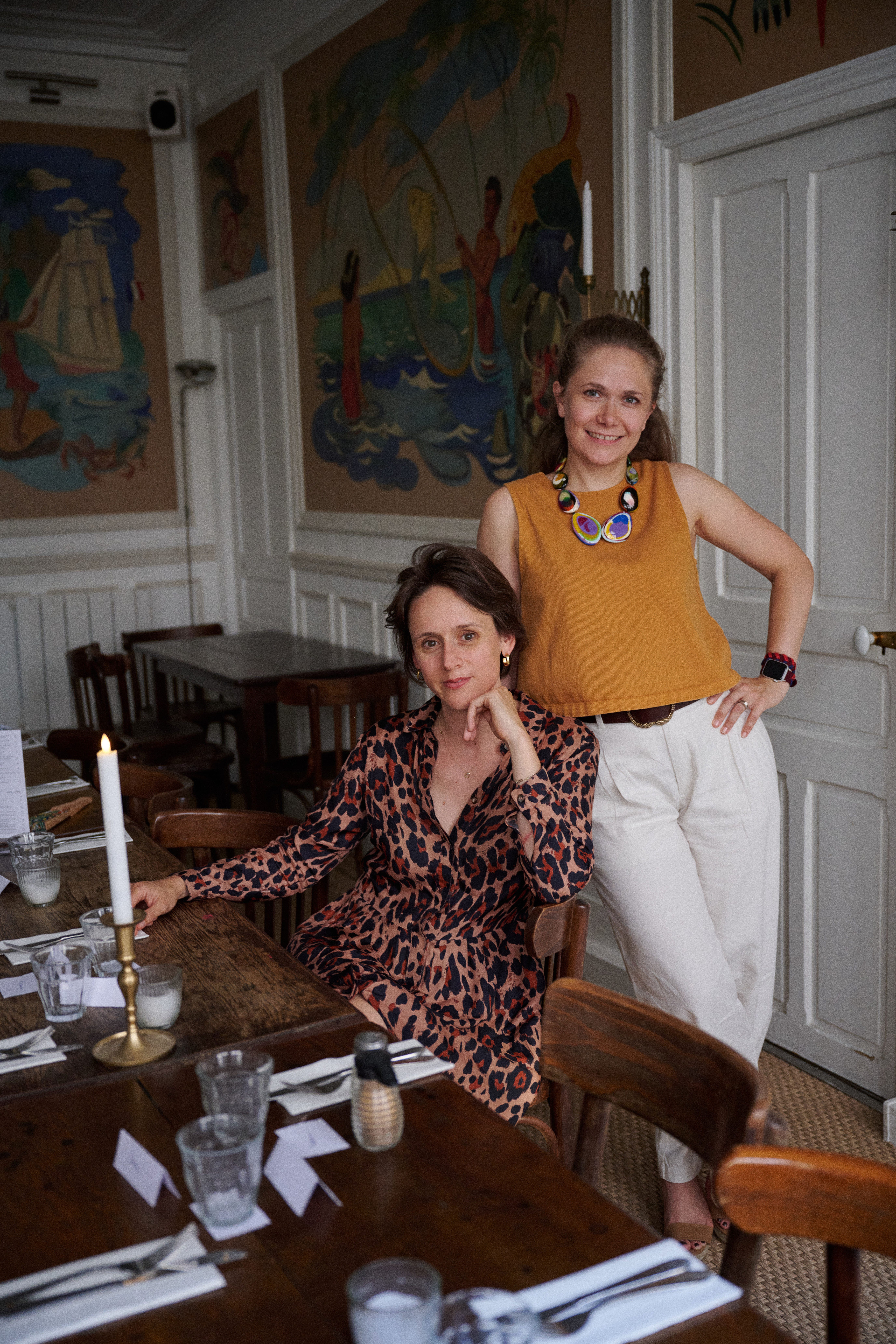
The idea behind Tandem began at a dinner table in Silicon Valley in November 2025. I had spent the meal talking about AI, but left with more questions than answers. After returning to Europe, I reached out to my longtime friend and fellow entrepreneur Marine, and we decided to keep the conversations going. In a couple of months, Tandem became a private dinner series where we invite ten guests from different disciplines to discuss how AI is changing our world. Every dinner, aka Edition, followed Chatham House rules, with no phones and no recordings. Here is what the first season taught me about preserving our humanity in the age of AI, and an invitation to the first dialogue of the second season starting in October.
AI inflates self-confidence and deconstructs self-esteem.
The extensive use of AI changes how we see ourselves. AI does not replace a profession outright, but it dismantles it by automating more and more of the tasks that define the role. When a colleague, for instance, stops asking us for something and hands it to an AI tool to complete instead, the shift can feel existential. The result affects our self-confidence and self-esteem more than we fully realize.
What’s the distinction? Self-confidence is the belief in one’s ability to complete a task, and self-esteem is the deeper, often unarticulated conviction that one’s value is independent of what one produces. For many knowledge workers, using AI increases speed and output, which grows our self-confidence, but AI also absorbs tasks that weaken our self-esteem. For instance, one designer can suddenly feel the boost of crafting the live version of the prototype they had in mind (self-confidence), yet experience doubts when realising their colleague had done their own design in the first place. For the heaviest users, or those most exposed to AI’s capabilities, this can fuel a fear of obsolescence.
American writer Matthew Crawford calls this phenomenon self-erasure. Drawing on philosopher Charles Taylor, Crawford argues that language is not a way to transmit what we already think but the process through which we discover it. What AI short-circuits is not the effort itself but the process in which we form our own ideas. When doing so, I’d push this further and state that when AI thinks for us, it keeps us from developing the best version of our thinking. This impacts those whose sense of self is tied to their work. Personally, I have always valued my work identity, even alongside my other identities as a friend, mother, or partner. When AI has an answer for everything, I wonder: how do I hold on to the effort that defines my professional self-worth? How do I not self-erase but rather expand thanks to the new tools? How do I redesign my own work and sense of contribution with this new lens?
The necessity of reintroducing friction
The second theme core to me for the first season was the relationship between resistance and friction. Whether the conversation was about seamless product experiences or interpersonal relationships, guests returned to this topic more than almost any other. Our shared observation: most GenAI products remove friction by default, so in order to continue learning and growing, we have to reintroduce friction by choice.
I call this phenomenon JONA: the Joy Of Not Automating. Why joy? JONA accepts that AI’s capabilities are continuously expanding the number of tasks it can handle and the quality of its results, but joy comes from deriving deep satisfaction in doing the work on one’s. We do the work because we want to, not because AI is incapable of doing it for us. This is the cognitive impact of adding friction back into our lives. Friction itself isn’t virtuous, and nostalgia for effort is not the point. Friction we choose is, and that choice is what separates JONA from mere sentimentality. This also extends to relationships as AI chats become our default conversation partners.
Relationships are core to our balance, self-worth and long-term health. Relationships need friction. Relationships are friction: that is how we live together, learn from each other, and leave traces of ourselves in each other. Our final Tandem edition was about transmission and the lens of young works. It was an invitation to consider what happens when our relationships, at work and beyond, are mediated by AI. Trans-mittere means to make something pass through. When we rely on artificial intelligence tools to answer all emerging in questions, this exchange between people is suspended, including the human chain along with it. The sharing of experiences, lessons learned from failures, and embodied perspectives and experiences no longer take place. The output is loud and clear. It instantly delivers an unyielding truth, depriving us of that transmission and of a sense of resonance within ourselves, of the practice of listening and receiving others’ views, but also the reflection that precedes sharing with others ourselves. When we lose this, we lose a core part of human relationships.
AI requires us to judge and suspend judgement
Most conversations lean towards judging AI too early or not judging it at all. Every Tandem Edition was an exercise in discernment. One vivid example was a discussion about AI companions and whether having a deep emotional connection to an AI was just awkward. A guest stalled the entire conversation by asking a simple question: “Who are we to judge?” It invited everyone to zoom out and suspend their judgment. Another conversation involved lamenting young workers dealing with unemployment. Another guest invited a mindful pause by asking, “What if our (older) generation was the one lacking imagination?”
Suspending judgment and recognising the situations where judgment should be held is hard, full-body work. Those two questions invited everyone around the table to pause. I was in awe of how the group welcomed those moments of reflection and paused even sometimes. Over the course of Tandem’s first season, we recognized when situations were not necessarily ours to rule on and when we could and should trust our intuition.
AI is eroding trust in society. We’re hoping to rebuild it, one dinner at a time.
Trust is fundamental to our shared existence. It is the infrastructure that enables us to safely cooperate without having to verify every term and individual. Yet as we use AI more and more, our shared realities are shaken. We don’t always know who and what to trust anymore, including ourselves.
Hosting Tandem dinners has been our act of resistance. Each Edition is an act of trust-building by hosting conversations in the spirit of learning and growth. We created psychological safety for guests to freely share their views, even when they disagreed with one another. Chatham House rules supported our mission, and revealing everyone’s professional identities at the very end removed any obvious power dynamics. Guests were finally given the freedom to think aloud in front of people who were genuinely interested in hearing and holding their perspective. The result was a renewed sense of belonging and trust among our guests.
I am very thankful for Marine, my co-curator, host, and friend, along with everyone who contributed to the success of Tandem’s first season. We’re kicking off our second season with a topic dear to me on October 7th (dinner in French, recap in English as well) and sharing our new look.
I look forward to deepening our conversation.
See you very soon…
Margaux