Ten days ago, Marine Buclon and I hosted a seventh and last dinner for our curated Tandem dinners. Here are the takeaways from our preparation and discussion, but also the full essay that concludes a few weeks of insights on the matter. The French version is available on our website directly.
Main takeaways:
1. Generative artificial intelligence promises the ultimate form of transmission: instant access to all the world’s knowledge. The models are trained on all available data and their users reach every conceivable (and probable) answer.
2. The first rungs of the professional ladder are being removed and the consequences are still uncertain. The “grunt work” handed to juniors served as an implicit form of transmission on arrival in the corporate world. By automating them, companies are abolishing “their school” without having decided to and without having solved the shortage of seniors that follows.
3. The cognitive and relational friction, removed by default, has to be rebuilt by choice. A few companies and schools are imposing arrangements that require framing the problem, failing or passing an oral check before turning to AI.
4. The “job apocalypse” narrative has been tempered by its own proponents, who have recently revised their forecasts downward. Macroeconomic data confirm this revision, showing no specific effect of AI on employment. That said, the data show that young people are operating in a labor market that is already stacked against them.
5. What remains to be transmitted is less a skill than a posture toward what is coming and how to make the most of it. Repetition, apprenticeship, and patience are growing rarer because AI makes the shortcut tempting. They grow more precious for the same reason.

The full version
Barely a few days after our dinner on trust, Leo XIV opened Magnifica Humanitas, his encyclical on AI, with this sentence : « Each generation inherits the task of shaping its own era, » The phrasing is not new, but it takes on a particular resonance in our present moment.
What exactly do we hand down, when the age reshapes itself faster than we can understand it?
This question ran through all our conversations across Season 1 of the Tandem dinners. Whether we were talking about careers upended by AI; the considerable impact of these tools on our cognition and our relationships; or even the immense productivity of a single well-equipped person, the themes of transmission and learning kept returning among the guests.
So we decided to devote the last dinner before the summer break to it. That evening, about ten people from worlds that rarely intersect gathered in Paris, from consulting to training to the student world. Phones stayed at the door and the Chatham House rule covered the exchanges. What you are about to read gives shape to a collective reflection: what was prepared beforehand and thought through around the table, then extended in the days that followed. The aim: to share it with everyone who lives with these questions without necessarily having the space to ask them aloud.
Transmitting means passing on to someone what one has made one’s own. Transmittere, in Latin, means to make something « pass through » and that « through » is anything but neutral. It denotes a resistance, a time of appropriation that must be experienced before anything can be transmitted, be it a body of knowledge, a judgment or a way of inhabiting uncertainty. Transmission demands time and friction.
AI disrupts this mechanism at both ends. It occupies the position of a transmitter without ever having been a receiver, giving back the knowledge accumulated by whole generations without having passed through it or absorbed it through effort. On top of that, for the first time at scale, the asymmetry of transmission no longer holds: command (or lack of command) of these new tools reshuffles the cards of knowledge and experience, especially inside companies, where the question arises of whether to keep recruiting easily automatable « junior » roles.
It was within this frame that we opened the debate among entrepreneurs, executives, teachers and students.
The rupture of apprenticeship
Who does not remember the long hours spent, early in a career, on the thankless tasks that English speakers call grunt work? One of our guests put it this way:
« Juniors earned their legitimacy by handling that thankless volume. It was tedious and badly paid, but it was the school. »
The junior who drafts a memo learns to frame a problem. The senior who corrects it transmits without having to spell it out. Tasks of execution build a field expertise and a professional intuition that no classroom training manages to install.
This mechanism has a name in the science of education. Victoria Marsick and Karen Watkins formalized it as early as 1990 under the term incidental learning : a form of learning that emerges from the work itself, as an unintended by-product of another activity. Grunt work is one of its most complete forms. No organization officially conceives of it as an object of transmission, yet it is perfectly woven into the gestures of the craft.
Now the AI systems deployed in companies absorb these entry-level tasks first: document research, first drafts, debugging, breaking a problem down. By automating this volume, companies effectively remove their environment of incidental learning. The effect plays out over two horizons. In the short term, juniors equipped with AI produce almost as fast as seniors, which installs an illusion of performance and masks the debt building up in the background. Over the longer term, the pyramid empties from the top, because no one will be able to settle the complex decisions that AI cannot yet make.
These observations line up with what a survey published by BCG in June 2026 among seventy executives documents : 53 % of them already observe a slowdown in the development of their juniors. A guest from consulting confirmed the feeling by asking: « Can you still become a senior in a field if you were never a junior first? » An experimental study run by Anthropic in February of the same year gives the measure of it : junior developers assisted by AI to master a new Python library learn faster than the control group but lose 17 % of their conceptual mastery. The largest gap concerns debugging skills, the very ones the company will expect of them to supervise the code produced by AI.
The paradox then closes back on the companies themselves. Convinced by the apparent performance of AI-equipped juniors, they raise their expectations and hand them tasks that an employee with five to ten years of experience used to take on, in the words of an executive interviewed by BCG. The imbalance is severe: more is asked of juniors whose real training is slowing down, for want of the friction that used to build it.
The “job apocalypse” narrative tested against the facts
This imbalance sits within a larger narrative. For three years, one prediction has saturated public space : generative AI will bring about a job apocalypse whose price the younger generations will pay. As early as 2025, Dario Amodei, founder of Anthropic, argued that half of white-collar junior jobs could disappear within five years, joined by his direct competitor Sam Altman a few months later.
These predictions, made by the very people building the technology, had a performative effect on the audiences they named, in particular the younger generations who internalized the forecast. In the United States, commencement speeches that are favorable to AI are regularly booed. According to Gallup, only 22 % of Gen Z say they are enthusiastic about the technology, down fourteen points in a year. The phenomenon has a name, FOBO, fear of being obsolete. It cuts across ages. To the juniors’ fear of not finding their place answers the seniors’ fear of being made obsolete by tools they have not mastered.
This fear produces paradoxical behavior inside organizations. According to a recent Writer.com survey, “AI adoption in the enterprise”, 29 % of employees admit to having sabotaged an AI rollout in their company, a share that climbs to 44 % among those under 30. These same employees nonetheless know that refusing the tool exposes them to layoffs more than the reverse. They prefer the risk of being sidelined to that of speeding up their own replacement.
For a few months now this narrative has met a denial from the very people who carried it, in a context where several of their companies are preparing to go public, each valued at around a trillion dollars. Sam Altman has acknowledged being largely wrong about the expected impact. Dario Amodei now speaks of an AI that would multiply human output rather than replace it, a thesis that leans on the Jevons paradox formulated in the nineteenth century and taken up by several promoters of AI : making a resource more efficient does not reduce its consumption but extends it to markets that were until then out of reach. The framework remains theoretical, since no data confirms its application to generative AI to date.
The available data stays consistent with this revised reading. As of June 2026, the Yale Budget Lab finds no statistical break in US employment since the release of ChatGPT in late 2022. A May 2026 paper by Lambert and Schindler, covering more than 243 million hires across four countries, goes further : as soon as remote work is introduced as a control variable, the specific effect of AI on junior hiring almost entirely disappears. Remote work makes supervising beginners more costly and undermines investment in profiles without experience. Attributing to AI alone what stems from a broader transformation of working conditions is a shortcut.
Finally, another signal weakens this apocalyptic reading: the economics of large-scale deployments turns out to be more fragile than announced. According to a Fortune article in May 2026, several pioneering companies are discovering that the running cost of their AI agents exceeds that of the employees they were meant to replace, once the cost of the tokens consumed and the residual human supervision that remains necessary are taken into account. Replacing human work with machine work is not an economically neutral operation, even if the way of working does restructure itself.
A study published in late June 2026 by Ramp and Revelio Labs, covering 21 559 US companies, adds a complementary signal. Companies that invest heavily in AI, around thirty dollars per employee per month in the first three months of adoption, saw their headcount grow by 10.2 % over the following two years and their entry-level hiring by 12 %. Low-adoption companies record no statistically significant effect. The authors specify that these gains concentrate in the technology sector. They add that the correlation observed does not prove causation. The founder of an AI-native company present at our dinner gave a concrete illustration : fifteen people today, ten hires planned by year-end, in a tech sector that captures the largest share of these gains.
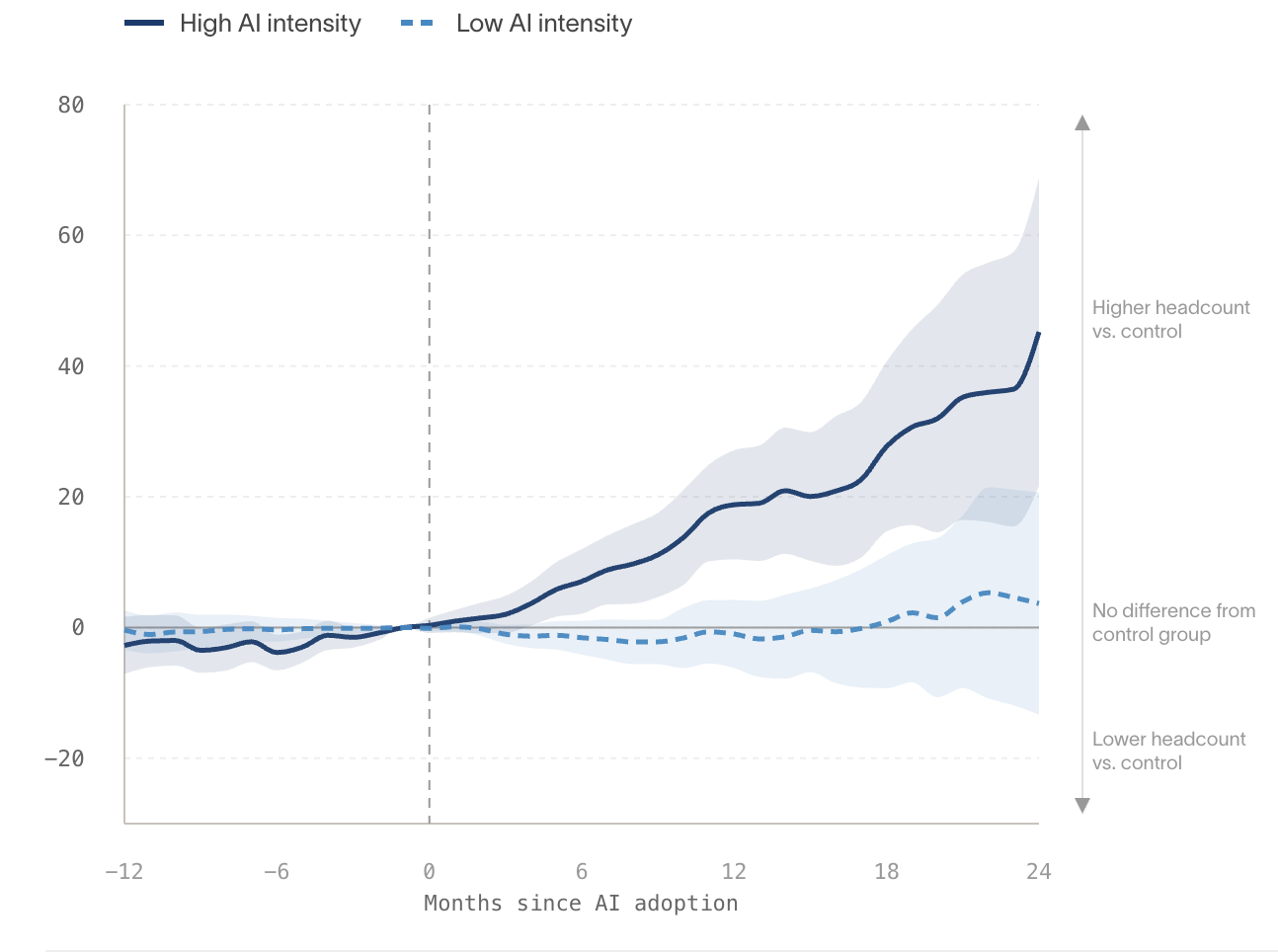
Outside the sector pockets Ramp identifies, the macroeconomic figures point more toward continuity, but young people’s felt experience remains legitimate, because the weight of the reconfiguration concentrates on them. France’s national statistics office, Insee, measured a 21.5 % unemployment rate among 15 to 24 year olds at the end of 2025, up 2.4 points over the quarter, while the overall rate rose by only 0.2 point over the same period. That represents 742 000 young people shut out of the labor market, 126 000 more in a year. IT employment among 15 to 29 year olds fell there by 7.4 % in the last quarter of 2025, even as the sector’s value added kept rising. In the United States, a study by the Stanford Digital Economy Lab documents a 16 % decline in the relative employment of 22 to 25 year olds in the occupations most exposed to AI, while that of seniors stays stable : the first steps by which one used to enter a profession are disappearing.
A student among our guests confirmed it: among his classmates, many still have not found an internship despite flawless applications, including the top of his class, who recounts sending around a hundred applications only to receive two replies. This example illustrates what the figures do not show: students sense that expertise matters, but they no longer know how to build it when the tools remove the friction that used to develop it.
Reinventing friction, rethinking transmission
Since friction disappears when AI absorbs entry-level tasks, we now have to design explicitly what used to be transmitted invisibly. A few organizations are already trying, with different logics.
At Shell, juniors have to frame the problem on their own before they can turn to AI to refine it. This sequencing produces better questions and clearer rationales, according to the results published by BCG. Friction is reintroduced at the precise point where automation removes it: the framing phase, the one that forms judgment.
Two other practices circulate the same requirement between generations in opposite directions. Salesforce has generalized pair programming by forming pairs in which the advanced AI user works alongside a novice colleague. The junior learns by direct observation, without going through formal training. Conversely, an innovative program organizes a co-development in which the junior who is comfortable with AI brings the tool and the senior brings judgment. A genuine co-development, its founder specifies, not disguised reverse mentoring.
These arrangements deliberately rebuild friction where efficiency could have done without it. An executive from the world of training offered an image that contrasts two ways of learning: the regatta and the offshore race. Training for the regatta prepares you to excel on a marked course, where the rules are known and the winner is decided at the margin. Training for the offshore race prepares you to navigate without markers, facing conditions that change and problems that no one has solved before you. These are two different kinds of agency, not two levels of difficulty. The first model long dominated schooling. AI makes the second indispensable, because it automates precisely what happened on the marked courses and leaves to humans the ambiguous territory of ill-defined problems.
The academic world faces this shift under a constraint of its own: where a company reconfigures a workflow that produces immediate value, the university has to reintroduce resistance in a setting where the student has nothing to deliver except the proof of having learned. A professor at a leading school explained that his institution pushes its students toward the experimentation of scientific research, in place of more classic exams (notably the final dissertation, obsolete in the age of AI). The founder of another academic institution describes a more operational setup in three parts. Some assessments are done without AI, on paper or with software that records the student and locks the browser. About a third is done with AI, on condition of keeping an AI logbook and providing coherent « logs ». A systematic oral then verifies real command of what was produced. The principle is explicit: most institutions leave their students in a gray zone where neither use nor verification is clear, which produces neither honest learning nor punishable cheating. Deciding which uses are allowed is here a necessity to maintain integrity and trust.
This shift is also visible on the recruitment side. Several recruiters present, including an « AI-first » entrepreneur, converged around the table on one observation: their main criterion has shifted from the signal of the diploma toward what one of the guests called « texture ». What they look for lies in a way of being and a singular way of approaching problems, a trajectory that testifies to choices and stories rather than to conformity with the expected path.
That said, these new routes of recognition assume resources that not everyone has. Selection shifts toward two terrains. The first is demonstrable skills on concrete projects, which a portfolio or a public contribution makes visible. The second is the social capital built in networks, through encounters and communities of belonging. A student from a modest family, geographically far from the ecosystems where opportunities circulate, with no spare time to build a portfolio outside their coursework, finds themselves excluded from both routes at the same time as they were already excluded from the classic route by the devalued diploma.
This blind spot ran through our conversation : the question of people in economic vulnerability, who have neither the social capital nor the demonstrable projects, found no answer. Recent initiatives such as the First Chance program run by Chance with Google Labs sketch a path, without the problem of massively funding reconversion being posed at its true scale.
What remains to be handed down
What the conversation lets through goes beyond the question of work. One of our guests put it this way: we have the material means to rethink how we live and produce, we may only lack the imagination to see what is beginning to emerge. The sentence moves the subject from diagnosis toward stance. What remains to be handed down is less a skill than a way of holding oneself in the face of what is coming.
In the corporate world, the example of Hermès offers an inspiring story. When demand explodes, the house refuses to set its production by the market. It paces its openings, a new leather-goods workshop every eighteen to twenty-four months, to its capacity to train artisans. An eighteen-month apprenticeship precedes the first finished bag. Each piece then carries the stamp of the person who made it. This refusal to sacrifice quality to volume produces a 40.5 % operating margin, a level no other luxury house reaches. Hermès has drawn what its leader calls a stitching line. Above it, nothing is delegated, neither to a machine nor to a subcontractor. Below it, they use ERP systems, e-commerce, cutting machines. The question posed to any organization is that of its own line: what part of its work would lose its value if we learned it had been done by a machine?
This stance is not an object that can be transmitted through content. It is built over time through exercises that resemble what craft has always practiced. Repetition refines the gesture. Companionship shapes judgment. Patience accepts that mastery cannot be decreed. AI makes these qualities rarer because it makes the shortcut more seductive. It makes them more precious for the same reason. What is quick to see is quick to copy. What is built slowly endures.
To close our exchanges, the words that crossed the table all said the same thing from different angles: transmission is no longer (only) about tools or skills, it is above all about a way of inhabiting the gesture and the bond:
craft, companionship, friction, beauty, wonder, doubt, creation, connection, moral robustness.
To hand something down in 2026 may be to hand down the desire to imagine what comes next rather than the fear of facing it unprepared.
Thanks for reading us! Sign up if you’d like to be part of the 2nd season of Tandem.
Marine and Margaux